How do Rokoko and MediaPipe differ in representing Staccato, Flow and Impact?
SECTION 01 // RESEARCH METADATA
BEWEGUNGSKUNST ALS DATENPRAXIS
A Research-through-Design comparison of Rokoko and MediaPipe as two distinct technical translation systems for human movement.
RESEARCH QUESTIONS
Which technical-aesthetic transformations emerge from these different capture logics?
STUDY STATUS Exploratory, situated comparison — not a technical validation or objective benchmark.
SECTION 02 // PROBLEM & APPROACH
Motion-capture systems are not neutral instruments of observation. They operate through specific technical logics that selectively capture, filter and normalise movement.
The comparative setup examines these logics not only technically, but as aesthetic conditions of the resulting movement images.
Rokoko and MediaPipe were compared not as competing products, but as two distinct technical translation logics of human movement.
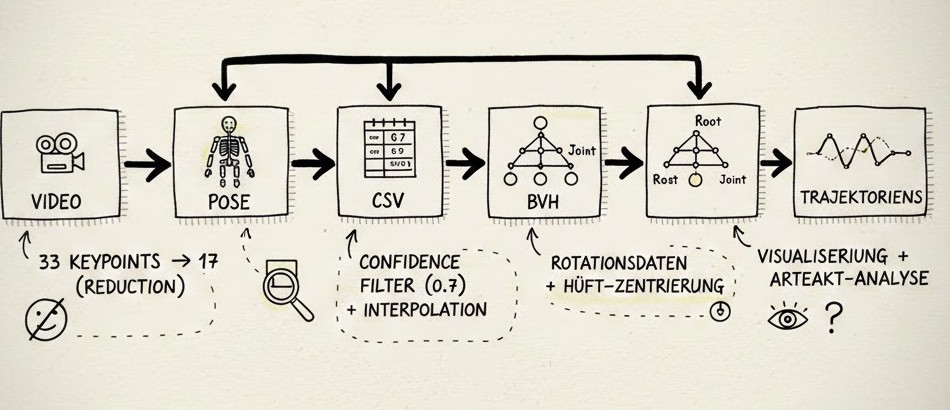
33 → 17 KEYPOINTS
CONFIDENCE THRESHOLD 0.7
INTERPOLATION
Y-UP → Z-UP
SEQUENCE-BASED COMPARISON
SECTION 03 // COMPARATIVE ANALYSIS — STACCATO, FLOW, IMPACT
Each capture system translates the same movement quality into a distinct visual signature—revealing interpretive character rather than a single measure of accuracy.
Not merely an error—
a visible signature of the capture logic.
MOVEMENT QUALITY
Sudden / Bound
ROKOKO
Abrupt, comparatively coherent directional changes with clearer temporal boundaries.
MEDIAPIPE
More visible temporal jitter, trajectory breaks and fragmented reconstruction.
AESTHETIC EFFECT
Staccato remains forceful but becomes more discontinuous and graphically segmented.
RIGHT HAND
LEFT HAND
HIP
LEFT FOOT
RIGHT FOOT
SECTION 04 // FINDINGS & EXPERT RESONANCE
Technical stability is not equivalent to aesthetic resonance.
Jitter, smoothing and reconstruction artefacts are not merely technical defects. Depending on context, they may alter, weaken or intensify perceived movement qualities.01 // TECHNICAL VS. AESTHETIC QUALITY
OBSERVATION
Stable tracking can preserve legibility without necessarily producing the strongest perceived movement quality.
IMPLICATION
Evaluate capture systems through technical performance and situated aesthetic effect.
02 // LMA AS HEURISTIC
OBSERVATION
Space, Weight, Time and Flow made differences between the rendered sequences discussable.
IMPLICATION
LMA can function as a perceptual heuristic without becoming an objective scoring system.
03 // LIMITATIONS AS INSIGHT
OBSERVATION
Jitter, smoothing and reconstruction changed the apparent quality of the same movement.
IMPLICATION
Capture limitations can be studied as evidence of translation logic, not automatically celebrated as aesthetic value.
EXPERT RESONANCE
Three movement-sensitive practitioners from performance, media design and film reviewed selected artefacts blindly.
Their responses provide situated reflection, not technical validation.
EXPERT RESONANCE // APPENDIX A
“This sequence feels very alive to me…”
E1 on Flow RELATED SEQUENCE // FLOW VIEW RELATED SEQUENCE ↑
“C feels somewhat flowy…”
E2 on Impact RELATED SEQUENCE // IMPACT VIEW RELATED SEQUENCE ↑
SECTION 05 // THEORETICAL FOUNDATION & REFERENCES
CONCEPTUAL FRAMEWORK
The study combines embodied interaction, movement-analysis heuristics and Research through Design as a comparative framework for perception.
-
DOURISH
Embodied Interaction
Movement and technology as situated, co-productive relations
-
BARTENIEFF & LEWIS
Laban Movement Analysis
Effort qualities as perceptual heuristics
-
FRAYLING
Research through Art and Design
Knowledge generated through design practice
-
ZIMMERMAN ET AL.
Research through Design
Artefacts as situated carriers of knowledge